

The following lessons contains information on basic individual and team tactics used in dodgeball. These are the first tactics which players should learn. More advanced tactics are outlined in our Player Development Framework and are explored in the Level 2 Certificate in Coaching Dodgeball course.
A summary of all the below tactics can be found in our Level 1 Tactics Resource:

Phases of the Game
With multiple balls in play and moving targets, dodgeball tactics are unlike any other sport. Firstly, it’s important for us to recognise the different phases of a game of dodgeball; this is dictated by possession:
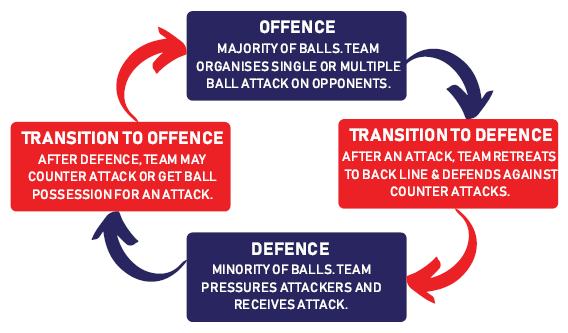
From Chaos to Organised:
When a group of new players are involved, it’s common that these phases never become clear as single-ball attacks are made sporadically and chaotically, meaning no team ever truly has possession of the majority of balls. Dodgeball matches should start to look organised and tactical as players learn to wait, communicate and work as a team rather than individually.
- Offence & Defence: The blue boxes in the image above are known as ‘closed’ play and should look very organised and coordinated.
- Transitions: The red boxes in the image above are classed as ‘open’ play. During these gaps between organised offence and defence, there are opportunities for players to make instinctive decisions regarding when to be aggressive and open play up by attacking or not, so these phases will naturally look more chaotic even in the most high-level and organised dodgeball matches.
Task:
Watch the following video of a Super League Dodgeball game. Can you identify offence phases, defence phases and transitions between them?
In-Game Communication
If players are going to communicate coordinated offensive and defensive tactics quickly, we need to give them clear and concise language they can use. A calling system is a quick way of communicating a play. Information included in a call should include an action being taken, a target and who is involved.
Calling System Examples:
- Some teams use positions and names to communicate who is throwing, e.g. John @ 4 or left pair @ 2 or John counterattack
- Some teams use numbers to communicate everything, e.g. 4,3 (meaning our 4th player from the left throws at their 3rd player from the left)
We encourage teams to be creative and design their own calling systems. Some example calls might look like the below: