


Dodgeball is well-known as being a fun, accessible game. But no sport is perfect, and all come with different issues. For dodgeball a big one is the ethics of cheating Vs ‘Taking your outs’ (being honest and removing yourself from the game if you feel a live ball make contact with you). In this lesson, we’ll explore this issue…
Imagine you are playing dodgeball and you hit someone. They pretend they haven’t been hit and continue playing. How would this make you feel? Imagine you are playing dodgeball and you hit someone. They pretend they haven’t been hit and continue playing. How would this make you feel? Pretty annoyed or frustrated is usually the answer.
Firstly, let’s look at the main reasons why someone may remain in the game when out:
Some of the above reasons are honest mistakes and can be combated with teaching and patience. Others however, are more sinister. If people do not play dodgeball with honesty, then dodgeball stops being a competitive sport and is instead just people throwing balls around in a room. This is just one of the reasons that we have the Dodgeball Code. The Dodgeball Code has been developed as an accessible and summarised version of British Dodgeball’s Code of Conduct. It is one of the most important aspects of dodgeball. It is about fair play, respect and sportsmanship.
The dodgeball code is as follows:
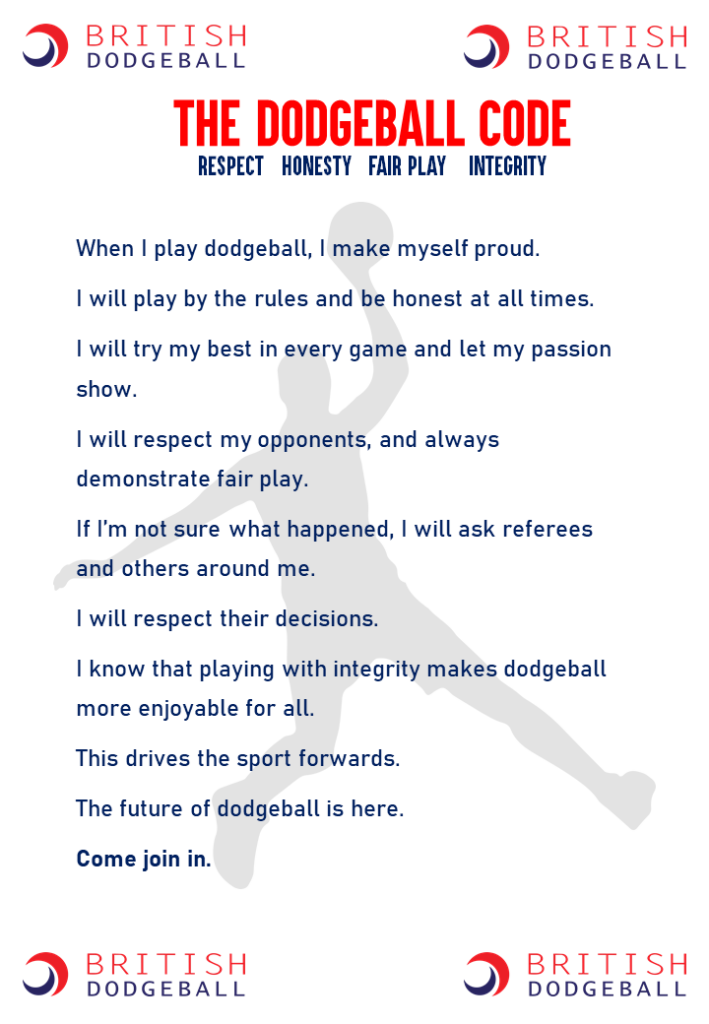
All dodgeball players have a duty to ensure they play by the rules and uphold themselves to the highest standards. Highly competitive play is encouraged but should never be displayed as cheating. If you respect your opponents, respect your officials and the decisions they make, then you respect the spirit of dodgeball. This will increase the integrity of the sport and the joy of play for all.
Demonstrating the Dodgeball Code:
- Declaring you’ve been hit when you feel a ball lightly skim you.
- Asking the referee when you aren’t sure if a ball bounced before it hit you.
- Trusting an opponent to go out if the ball hits them.
- Letting the referee make a decision, and respecting it even if you do not agree.
- Treating your opponents with respect by introducing yourselves before a game.
Our ultimate aim for dodgeball is where a referee is hardly needed because the players follow the rules independently with integrity. Referees would only then be required to time matches, record scores, call ‘play ball’ and make decisions on really close calls where a player isn’t sure what happened.
If a player is consistently cheating or showing a lack of respect, then referees can issue progressive punishments. This might look like issuing a warning for a first offence, calling them out for a second offence, giving them a blue card (where they need to miss the next set) for a third offence and giving them yellow or red cards if it continues.
Coaches and spectators should also follow the Dodgeball Code and trust players to be honest at all times. This helps to make players and referees feel respected and safe. For instance, a player could be really put off if a spectator yells at them to go out if a ball that the player knows has bounced hit them.
We recommend showing everyone the Dodgeball Code before you begin playing. This might be on your website, or as a print-out in your school hall so you can keep referring to it. You can access printable versions and certificates here.
Task: